This interview originally appeared in Ripper number 3. Thanks to Tim Tonooka for permission to reprint it.
Black Flag is one of the greatest hardcore punk bands around. When they play in San Francisco, loyal fans come from as far away as Reno to see them. They play with a fierce intensity that few other bands can match. Their music is fast, loud, hard, raw, and savage. Their songs are about urgent feelings that any punk can relate to. The first time I went to see them in March of this year at Mabuhay, I had never heard of them or their music, I just figured-that any band with the name "Black Flag" must be alright. When they came on stage it was incredible. If you like hardcore punk, you owe it to yourself to get their records and go see them live. You can also see them in a film by Penelope Spheeris, "The Decline Of Western Civilization," along with a bunch of other LA punk bands. They're also on the live soundtrack album of the film, on Slash Records.
Black Flag puts out some of the most awesome hardcore punk sounds around, and they do it without any of the stereotyped punk posturing. No silly costumes for these guys. They don't put on any airs either. When they're not on stage, they hang out in the audience and enjoy talking to their fans.
Black Flag's first record, "Nervous Breakdown," with "Fix Me," "I've Had It," and "Wasted," is one of the all time punk classics--fast, furious, and hard. The vocals are by Keith Morris, the original singer of Black Flag. He has a really great vocal style. You can see him with the Circle Jerks, the LA punk band he's now with.
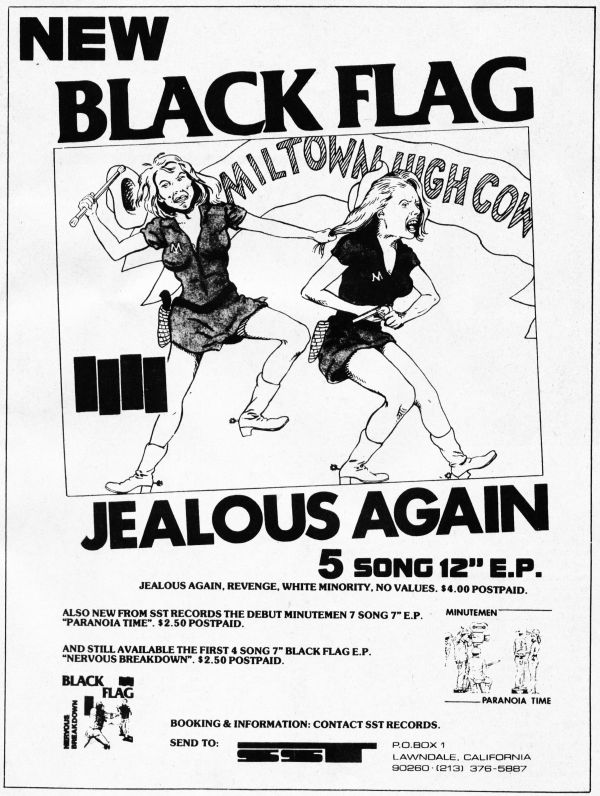
The second record from Black Flag will be out by the time you read this. It's a 5 song, 12 inch EP with "Jealous Again," "Revenge," "White Minority" and "No Values." These songs sound great live, so keep your eyes peeled for this one. They started recording it a year ago, mixing it over and over until they were satisfied. The vocals are by their second singer, Ron, a short Puerto Rican guy who was a real vocal powerhouse. He ran, jumped and lunged around, and seemed to be all over the stage at once.
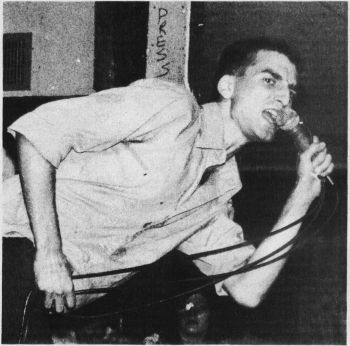
Dez, the new singer, is a lot taller than the two previous singers. He paces the stage from one side to the other as he blasts some really mean vocals into the mic. He'll be singing on the third record from Black Flag, which is in the works.
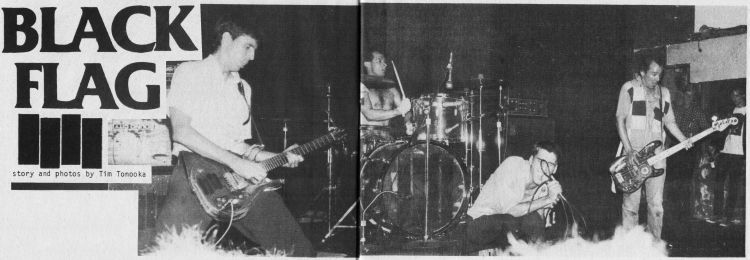
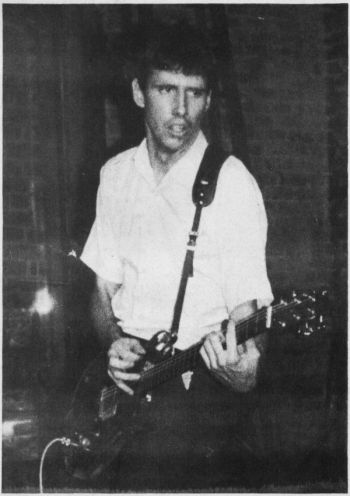
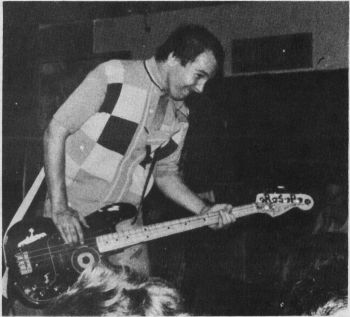
Greg is the ultra-fast, frenzied guitar player of Black Flag. His right hand is just a blur as he plays. Chuck is the maniacally frantic bass player. Before he goes on stage you'll see him with his unplugged precision bass around his neck, his fingers twitching at the strings. And Robo, the drummer, pounds away and crashes the cymbals at a fever pitch.
It's hard to describe the intensity of Black Flag's performance in words, and photos only take a split-second moment out of context. It's something that you just have to see for yourself to believe.
A while back, before he was in Black Flag, Chuck rented a studio on the third floor of a Long Beach office building, where he lived for three weeks. During a wild party that was going on there, someone called in a SWAT team because some guys were shooting bottles off the edge of the roof with BB guns. A helicopter came, police cars surrounded the place, shouting through bullhorns. The SWAT squad climbed the walls on ropes and smashed in the doors. They came in with shotguns and searched the people at gunpoint, looking for a cache of arms. They didn't find any but Chuck got evicted that night. He used to get stopped and searched while driving in Hermosa Beach, but he doesn't live there anymore. He was told, "Don't come back ever. If you come back you'll wind up first in the hospital then in jail."
The last time I heard, the guys of Black Flag were living in Torrance, but as Chuck says, they're "always on the move, one way or another."
Black Flag has played up and down the West Coast, from San Diego to Vancouver, and inbetween at places like Seattle, Portland, Sacramento and Santa Cruz. They play in San Francisco just about every month, usually at Mabuhay, and they've also played the Stone, the Geary, and Berkeley Square. Black Flag recently had their first gig at the Starwood in LA, but they've been banned from the Whisky and some of the other clubs there. They've been having a lot of problems with police at their shows lately, with 25 squad cars showing up for one of their gigs, and they had cop hassles in Phoenix and Tucson.
At the end of November, Black Flag will return to play Phoenix and Tucson, and then they're off to play Texas on the way to their first East Coast tour, where they'll play New York, and maybe New Orleans, Georgia and Boston.
When Black Flag is on tour, they sometimes bring someone along to help with the sound, but usually the four members of the band just pack themselves and their equipment into their van and do everything themselves. They do their own booking, promotion, management, everything.
Black Flag played Santa Cruz awhile back on September 6, with DOA, a great show that a bunch of RIPPER people went to, including myself, Violet Vamp, Earnest Endeavors, and Phil Tiger. This is where the following interview took place.
 TIM: How did you come across your latest singer?
GREG: We've known him for a long time. He was in this band called Red Cross, and he was a real good friend of ours. He was playing guitar in Red Cross, he wasn't singing.
TIM: What kind of interesting things did you do before the band?
DEZ: Not very many. But I've been into music since I was little. My dad was a record producer for Fantasy Records, which is basically a jazz oriented record label. He used to own a record store in New Jersey, where we used to live. Ever since I was little I used to listen to music. I started playing guitar when I was 12. I used to ditch school and go to the library and read, cuz I didn't like school. Actually, I haven't even graduated high school. I need about a year to go. I used to hate school, and I used to hate going out with all the hippies over there and smoking dope all the time, so I used to ditch school, and go to the library, with another person if I could get someone to go with. And do something like that. But I've only been playing in bands, like garage bands, for about the past two years. I played in ten different ones. I was in Red Cross for about six months. Reformed Red Cross, not the original. Playing guitar.
GREG: Yeah, they're real good. They're on the Siren album.
EARNEST: How long have you been in Black Flag?
DEZ: About 2½ months. But I'd been watching the band, going to see them play for about two years, since like early '78, or something like that.
PHIL: Had you been a singer in other bands?
DEZ: No. Usually I play guitar.
GREG: Yeah, Dez plays guitar real good, and what we want to do is eventually, he's gonna play on some of the songs, the guitar as well as sing, so that way we can do a little bit more. We have some ideas for using songs that would be better with two guitars. We've been working on it, but as far as playing that way, we haven't yet, but we're going to. I think it's gonna fit in real good. It'll just give us more to work with. More freedom for doing some stuff that I've always wanted to do. I always really wanted to have two guitar players, but when the band started, it was hard enough finding a drummer and a bass player that would play this kind of music.
TIM: This was in '76?
GREG: Well, when I first started wanting to get a band together was the summer in '76. And I couldn't. I tried to get some people to play my songs, but--
DEZ: People around where we live are too spaced out anyway. It's the beach area, they like to sit around and smoke a lotta dope.
GREG: Yeah. People are into way different music than I was. Especially in the area that we live.
DEZ: Yeah, they like the Eagles, and Jackson Browne and stuff.
GREG: Or progressive music like Genesis, or something like that. I was really frustrated, because I finally got to the point to where I had songs that I wanted to get out, and I couldn't, I didn't have a band. It took about six months till I got Keith, till I met him. I was really surprised that he was into a lot of the same stuff I was because where we live, nobody was into it, hardly. For a long time I didn't think I'd ever get a band together, but I was happy just writing songs for myself, just as kind of a outlet. Like when I was going to school, I'd come home from school and just play really hard.
TIM: High school?
GREG: No, college.
TIM: Did you finish that?
GREG: Yeah, I did.
TIM: What were you majoring in?
GREG: Economics. I studied a lot of different stuff though. I really liked school, when I was in it. But by the time I was finished, I'd had enough of it. You can kind of work around the structure, and you can really get a lot out of it, that you want to, if you work it right, but I don't think most people do. I think most people in school have the wrong attitude, as far as getting what they want to study out of it.
TIM: They're more interested in just degrees and stuff, than in learning something?
GREG: Yeah. Or getting a job. I figured school would be, I would learn what I wanted to learn, and what I was interested in, rather than try to learn to fit in with some job or something. But I just used to play for fun, for myself, cuz I didn't have any ambition to get in a band and play other people's songs or anything. I just wanted to play what I wanted to play. I wasn't in any other band. This was the first band I got started. I just wanted to start a band that plays like we do. I was trying to get a band together for a long time, and I got Keith, our original singer. He wanted to play drums, and I told him, "No, why don't you sing," cuz I thought he'd be real good, and he didn't have a drumset, and I thought he'd be a better singer, and we could find a drummer some place else. A friend of his played drums and we got him, and then we got the bass player, and we started playing our original songs and stuff. When we first started, nobody liked what we were doing. Absolutely nobody. But we liked what we did. And then after a while some people started liking it, punk rock became something, the scene grew out of it, and things changed in people's lives.
 TIM: How long ago was it that you started?
GREG: It was about 3½ years ago, really, when me and Keith started the band.
TIM: You weren't really classified as punk back then?
GREG: In '76, where we live, we played parties and people didn't know it was punk, they didn't say, "That's a punk band", they didn't know what it was. It was just hard and fast, as far as they were concerned. It wasn't till much later that people developed a strong media image of punk. People were a lot more open to it originally at first.
CHUCK: They would call it punk, I mean, but the Ramones style thing. The Ramones were around, and they called it punk rock. The thing was, there wasn't this really strongly defined attitude towards it. So you could go to a surfer party, or a party full of longhairs, and play, and have fun. They weren't all already decided.
DEZ: Cuz it was something new, and they could get into it.
PHIL: The media hadn't stepped in and categorized it.
CHUCK: They had a name for it, but they didn't have any attitude.
TIM: So at that time, nobody had decided that there were any "rules of conduct" that an audience had to conform to, to listen to that kind of music.
GREG: Yeah, right. Where we're from, and then that was being developed in certain circles real quick, and then it finally, within a year ago, it hit the mass media all over the place, to where your average person, you talk to him on the street, and they have an idea of punk which is quite a bit different than I did when I first got into it. I mean, as far as I'm concerned, the media image of punk can die, I wish it would die. I don't think the media has done--I think it's done a lot of harm, actually.
CHUCK: It's made it bigger, though. It gave it a lot of notoriety to where a lot of people who would never experience it at all, have gotten into it for either the right or the wrong reasons.
TIM: How long was it before you really started to develop the kind of cult following that you have now?
GREG: About a year and a half ago, really. We couldn't get gigs, because we were from outside of the established scene. We just rehearsed for two years.
CHUCK: We played parties and rehearsed and had parties at our studio. We had a good time, but we weren't allowed out into the public eye. The first gigs we got we had to put on ourselves. We would rent a hall and do it ourselves.
GREG: When our EP came out, we got some good reviews and people basically had to start giving us some gigs, but
the scene in LA was really closed, and we were from a little bit outside of it, to we were never accepted at first there. But we still had fun, we just played for ourselves, mainly.
PHIL: What were you guys fighting against there?
CHUCK: In Hollywood, everybody's in the middle of the city, and if you're not from Hollywood, you're not a city person, and you're not urban, you're not tough, you're not a punk. They look at us, we dress like we do, we're from the beach area, and they just kinda go, "SURE you want a gig. Right. Fuck off."
TIM: You're still based in Redondo Beach?
CHUCK: We're Hermosians in exile.
GREG: I used to live in Hermosa beach, but we're gonna have to move. We don't have a place right now.
CHUCK: If I return, they'll give me a free apartment in the Hermosa Jail.
TIM: What's this wierd story about "slam dancing" that was in the LA Times?
GREG: Nobody I know of had ever heard of "slam dancing", or ever heard of that term, till that article was printed. And then it qot picked up by some of the wire services all over, and people asked us up in Vancouver and all over the place, what "slam dancing" was, and they said they read about "slam dancing", and we never heard of it, and nobody else has.
(Then we started talking about LA)
GREG: The scene has changed, with the influx of suburban kids and stuff...
DEZ: A lot of the original people on the scene dropped out, and just stayed home.
CHUCK: For various reasons.
DEZ: They have normal jobs now, and they're getting married.
CHUCK: Yeah, it amazes me. There's a bunch of punks that are getting married. That's the first time that I've been around the scene long enough, cuz when I got outta high school, I lost complete touch with all my high school friends and all that, and all of the sudden you're on this other thing, this punk rock scene, and you see all the normal stuff goin' on. People droppin' out of it for those reasons. That's why our second singer quit, was to go normal with a girl.
TIM: That was Ron?
CHUCK: Well, that's just a pet name, Ron. Chavo Pederast.
GREG: That's his real name.
TIM: Why did Keith leave?
CHUCK: Keith left because he wanted to stay exactly the same. Our music was changing, and he didn't like a lot of our new songs.
DEZ: Same thing with Ron. He didn't like any of the new songs either. But he left for a different reason.
CHUCK: If you want an involved reason, here's how it goes. You get out there in front of people, you're doing it, you're up there, and that's you. Now this is when you first start out, you got no friends on the scene and all that. You just do it. You believe in what you're doing, you say, fuck 'em. If they like it, they like it, if they don't, they don't, and you goddamn well try to make an impression on 'em. And then after you've done it for awhile, you got all these friends out there and everything, then you've got a cool, something where people have become accustomed to a certain thing that you do and a certain type of thing that you're putting across. Now, every song we do is slightly different, there's a different approach in every one of 'em. We don't just write four Nervous Breakdowns. We don't have any song like Nervous Breakdown, just one. We don't just pump 'em out like that. It's not a formula. And so, at a certain point, they don't want to take the risk that all their friends will go, "What a geek!"
GREG: Yeah, basically Keith wanted to be in a band, and he told us that he wishes we had more songs like White Minority, which is 3½ years old. We like the song, we still play it, but you gotta keep doing new stuff.
CHUCK: It's an emotional thing. The fear of doing anything new comes out of that. It's a resistance to new things, and you find it especially when someone gets older.
 TIM: Your new record is the first in a series of twelve inch EP's?
GREG: We have the first one recorded, and the second one just about recorded. Our original EP was recorded about 2½ years ago, so we're really anxious to get something that is more like--
CHUCK: What we are now.
TIM: How would you describe the way your sound has changed?
CHUCK: We get faster. I got a new bass amp, new cabinet. It's not quite as noisy. Our first one had a board on the front, it wasn't really bolted on, and it used to move in and out about an inch and a half as I played. The guys described my bass sound as a muffler dragging on the ground.
TIM: Does Black Flag stand for anarchy, or is it the insect killer?
CHUCK: It does stand for anarchy.
GREG: Yeah, it's not the insect killer.
TIM: What are your ideas about anarchy?
CHUCK: My definition of it is, a commitment to change, no system. Cuz the world really is anarchy. But a person committed to it is committed to destruction of the status quo. So anybody who's pushing what exists, then is at least one of the spoons in the big soup of life.
PHIL: Who writes most of the material? You do?
GREG: Yeah, most of it. But other people in the band write something too.
TIM: What are your songs about?
GREG: The songs that are important to me are mostly very personal, and they deal with my own feelings.
DEZ: They deal with everyday things that may happen to you.
CHUCK: They deal with emotions, and It's a way of getting them out. Our basic viewpoint is personal.
TIM: What are the things that drive all of you to be so intense on stage?
GREG: We just play like how we feel it, we never really analyze it like that.
CHUCK: It's the only way out.
DEZ: Any other way you get bored.
CHUCK: Otherwise, I'd fuckin--if I didn't do that, I would chew people's heads off and stuff, or--I used to race motorcycles and race skiing and stuff like that. I just put the same physical energy into that. You do it until it pushes your body hard enough to where you get complete release. I mean, I think different people are a different way, ask any girl about any guy and she'll tell you the same thing.
TIM: How about a word from the drummer?
ROBO: Hi.
GREG: He doesn't usually say that much.
(I mentioned the record companies in LA)
GREG: The record companies have nothing--
CHUCK: The fuck at all to do with what we're doing. None of them are interested at all. They just want bands that sound like the Knack.
TIM: You're not trying to be commercial, that's not your goal.
GREG: No. We just want to get our music out, the way we want it to be out.
CHUCK: We got stuff to say and things to do and we'll do it.
TIM: And if they don't like it?
CHUCK: Well, they don't have anything to do with it, so fuck 'em.
GREG: Yeah. We don't think about record companies.
CHUCK: They're gonna have to send muscle guys over to deal with us if they want to--
TIM: It's good that there's bands that won't cater to their every whim.
GREG: There's a lot of 'em in LA. There's all kinds that are trying to get signed in LA now, but there's a whole lot of really good bands that are just operating outside of that. I mean, it's just not something we ever think about or would even deal with at all.
TIM: That's what your fans like, is that you take a very uncompromising approach.
GREG: Well, yeah. Otherwise we wouldn't do it.
CHUCK: Yeah. If you want to make compromises, then you might as well be working or something. I'd rather make my compromises there, and still be able to do something that was really all me, and all the way I wanted to do it. Otherwise, you're nobody anywhere. At least you get to be somebody in one situation.
GREG: Yeah, we're not elitist, we don't want our music to stay in a closet, but we're not gonna change it for anybody, we want it to get out as much as possible, without changing it. So we try to promote ourselves the way we want it to be. And that way, we have control over it, and no one can change it.
TIM: Do you do most of your own promotion, and booking, and things like that?
GREG: 100%.
PHIL: Do you do your own distribution too?
GREG: A lot of it. We go through some distributors, and also wherever we go we get 'em in stores, too. We take 'em along. But they go through some distributors that get 'em into various stores. You can't get distribution like a major label in every store all over the place, because there's not that kind of distribution available to a small label like that.
TIM: What exactly is SST records?
GREG: It's our own label. It's like Black Flag Records, but there's gonna be another band's record on it, a band called the Minutemen, from San Pedro, California. They're really good.
TIM: How did you come across your artist? (Raymond)
GREG: He's my brother.
TIM: You seem to do a heavy amount of touring.
GREG: We're starting to do that, and we want to play as many places as we can. If we can afford to get there, then we'll do it.
CHUCK: Rather than just in-breed in LA.
GREG: We're gonna go all over the place. Any place that'll have us.
DEZ: As far as we can go--
GREG: We'll go. We want to go a lot of places, and that's what we're shooting for right now is--
CHUCK: Play in front of as many different people as possible.
PHIL: Each one of you are completely committed to the band, your music?
CHUCK: It's the only reason I do everything I do.
GREG: We work, but we work to support the band.
TIM: What do you do for a living? When you're not doing the band?
CHUCK: I used to make pool tables and stuff, worked for a company that did that, then I quit that, and I'm fast running out of money.
GREG: Yeah, he saved some money and put it into some of our recordings, and I build electronics equipment.
 TIM: What kind of equipment?
GREG: Antenna tuners.
DEZ: I used to make scuba gear, but I had to quit my job to go on tour.
TIM: And Robo?
ROBO: I work in a warehouse.
TIM: Tell me something about your personal background.
ROBO: This is the first band that I've ever been in. I joined it about two years almost. It's been fine since then. Been working hard on it.
TIM: What did you do before you were in the band?
ROBO: I used to work, basic factory work. Warehouses. Regular factory work. Not very much into playing anything. I used to play marching drums when I was in high school, that was a long time ago. That was about it. Never had a drumset, till about late '76, I first picked up a drumset.
TIM: You got into Black Flag pretty quick after that?
ROBO: Yeah. They were looking for a drummer, since they lost the first one theu had. So I saw a flyer up in Hollywood, called them up and that was it. Started rehearsing. It's been going pretty fine till now, so we hope it keeps going good.
TIM: Chuck, what were you doing before you were in the band? You said cycle racing, and--
CHUCK: I did that. I went to school a lot.
TIM: Did you go to college?
CHUCK: Yeah, shit yeah. I went for four years to college. Then I burned out on it. I just gave up. I went four years, one unit short of graduation from University of California.
TIM: LA?
CHUCK: No. I went to Santa Barbara, LA, and Long Beach.
VIOLET: Did you study music at all?
CHUCK: No.
VIOLET: What did you study
CHUCK: I studied psychobiology.
VIOLET: Sounds interesting.
CHUCK: There's a lot of pharmacology and drugs. I did brain operations and things. I used to cut open rats and put electrodes in their heads and stick drugs into them and watch what they did, and theorize about things, and everytime I had a new idea I would figure it out down to that stage and then I would test it. That's actually what led up to all this. At a certain point I ran into some brick walls in the institution there, in the school thing. They started saying, "No, you can't do that, no, you can't think that way, just do these stupid little things, and quit thinking." You know what I mean? They actually told me, "Stop thinking and just start solving these little teeny problems for us", you know, like "Well, we've done this, this, and this, and we got this little, little hole that needs to be filled in, right? So why don't you fill in the hole and decide whether it's A or B that does this. It's either A, B, or C, and we got to find out which one, we're too lazy to do it, so you do it for us."
TIM: Were you in another band before this?
CHUCK: Yeah, I was.
VIOLET: Was it the same kind of stuff you're doing now?
CHUCK: Yeah, pretty much. This band practiced next to our band, and they didn't have a bass player. After the third time I heard 'em, the songs were grinding through my head all the time, and I went, "They're great!" And I was always running around going "I...am going...to...explode, I'VE HAD IT!" So I started playing bass whenever they did parties and stuff. Then I quit the other band, cuz all the other guys started listening to Jimi Hendrix. So I go, "Fuck this shit", and moved on. Which was lots more fun and more energy and all that, you know, that's where all the other stuff comes in. That's why I got an inclination to why I play bass, is because I'm into things on a physical level. The mental level is for ideas, and talking, not for playing. If you want to prove you're smart you don't play music. That's what's wrong with all these progressive assholes. They're out to prove they're smart. You got to feel that if you're smart it'll come out one way or another. You don't have to get pretentious about it.
VIOLET: How do you find the scene over here different from the scene in LA?
CHUCK: The Bay Area is basically less violent, less agressive, all the way around. People are into an intellectual thing and proving how sharp they are. They all want to tell people that they're smart. So they listen to bands that have that kind of a pose, some guy going "dingladepobumpadeedleleedleadeep", and talking about shopping or something. It's spun off, and all that, but you can get elitist about it. You can go, "I understand and you don't." Whereas if you do something that's really direct, everybody understands, and you can't get elitist about it. But then there's also, the Bay Area just REEKS of hippie damage. From the sixties, cuz it's where the sixties happened the biggest. The cops and stuff are all stoned on pot all the time. I got arrested for spray painting graffiti in San Francisco, and the cop apologized for busting me. In the end, he told me just to use a different color paint. In LA I'd be facing a $10,000 fine.
TIM: I heard that you were being sued for visual pollution.
CHUCK: I don't know anything about that. We're not being sued for anything. Except maybe, the Orange County school system would like to find us to sue us I'm sure.
TIM: What for?
CHUCK: For putting up flyers and spray paint and stuff like that. A lot of fans in Orange County, they put stuff up, and we've put stuff up down there, a lot of graffiti for us down there. They called me up one time.
GREG: (laughing) They said we did $5500 damage to this one school, and more at this other school. We told them, "Well, sorry about that". We told them we'd love to play a benefit for free.
CHUCK: I told them, "I'll play a benefit for free, and you can raise the money from that, otherwise, really, it's like squeezing blood from a rock, because we don't have any money."
GREG: We're already in debt as it is.
TIM: What do you think when you hear people say that punk is dead?
GREG: The people that say punk is dead, most of 'em--
CHUCK: Didn't want it to happen when it did.
GREG: For one thing, it depends what they mean by punk. If they're talking about punk as a image, or punk as a group of bands, or whatever, that does make a difference. But most of the people that say punk is dead, are just burnouts that want to smoke some pot, and listen to some ska or they never liked it in the first place, most of 'em.
CHUCK: It was just a big strain, to have to put up with it for a little while.